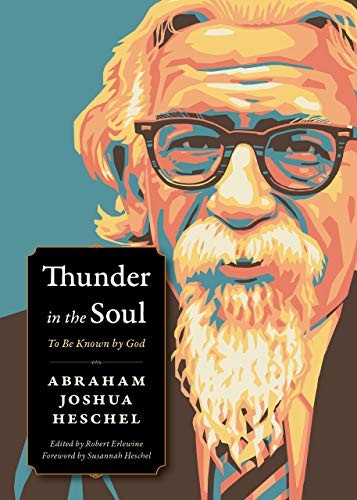
Thunder in the Soul
Jewish Thought & MussarSelected Passages
Selected passages
Always remember that God needs us, that we are an object of divine concern
Jews have not preserved the ancient monuments, they have retained the ancient moments
In the artificial light of pride and self-contentment we shall never see the splendor. Only in His light shall we see the light
The problem of living begins, in fact, in relation to our own selves, in the handling of our emotional functions, in the way we deal with envy, greed, and pride. What is first at stake in the life of man is not the fact of sin, of the wrong and corrupt, but the neutral acts, the needs. Our possessions pose no less a problem than our passions. The primary task, therefore, is not how to deal with the evil, but how to deal with the neutral, how to deal with needs
Most of us do not know the answer to one of the most important questions, namely, What is our ultimate concern? We do not know what to pray for. It is the liturgy that teaches us what to pray for. It is through the words of the liturgy that we discover what moves us unawares, what is urgent in our lives, what in us is related to the ultimate
The highest peak of spiritual living is not necessarily reached in rare moments of ecstasy; the highest peak lies wherever we are and may be ascended in a common deed
A Jews is asked to take a leap of action, rather than a leap of thought. He is asked to surpass his needs, to do more than he understands in order to understand more than he does.
We stand on a razor’s edge. It is so easy to hurt, to destroy, to insult, to kill. Giving birth to one child is a mystery; bringing death to millions is but a skill. It is not quite within the power of the human will to generate life; it is quite within the power of the will to destroy life
Indeed, the awareness of the weakness of the heart, the unreliability of human inwardness, may perhaps have been one of the reasons that compelled Judaism to take recourse to actions instead of relying upon inward devotion. Perhaps this is the deeper meaning of the Rabbis’ counsel: one should always do the good, even though it is not done for its own sake. It is the act that teaches us the meaning of the act