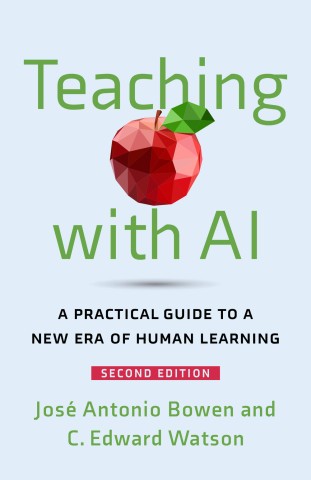
Teaching With AI
Personal Growth & WellbeingSelected Passages
Selected passages
As one faculty member writes, "It's almost as if ChatGPT is fine-tuning my brain to be a better instructor by enabling me to see in intimate detail how students interact with it... Thinking of ChatGPT as a co-instructor rather than a competitor has helped me create a personalized learning environment and recalibrate how I think about education"
Since AI use natural human language, it also needs human-level precision. You need to provide instructions as you would to an especially literal minded intern on his first day working with you.
Better prompts anticipate the range of possible ways to interpret the task and provide guidance.
Al performs much better when you're more direct: Negative commands are also confusing to an AI. Converting to positive instructions will often improve results.
Al allows you to customize problems or tests for each student. At one level, this could be a strategy to reduce the ease of cheating: five hundred versions of the problem are just as easy to create as one. Since AI makes it easier to make tests, you can now give more tests with lower stakes. More assessment means that each test has a lower weight, which reduces the motivation for cheating
Students are more than twice as likely as faculty to say that using AI has a positive impact on learning (47% of students vs. 22% of faculty), while 50% of faculty believe that the impact is negative with only 22% of students agreeing (Shaw, 2023)
For most of us, more encouragement and less instruction would better align with the science of effort, self-efficacy, and learning.